2205

From TekWiki
Jump to navigation Jump to search
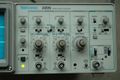
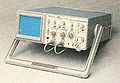
Tektronix 2205
20 MHz dual trace analog scope
Tek 2205

Produced from 1989 to 1993

Manuals

(Manuals are OCRed PDF files unless noted otherwise)

Manuals – Specifications – Links – Pictures

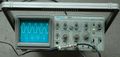
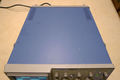
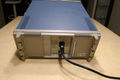
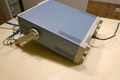
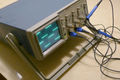
The Tektronix 2205 is a 20 MHz dual-trace analog oscilloscope introduced in 1989. There is a also a 40 MHz version, the 2205-40. A 2205 equipped with option 07 (internal DC inverter) can be powered ≥3 hours from an 1104A battery.

Key Specifications

Risetime 17.5 ns @ 20 MHz, 23.3 ns @ 15 MHz
Bandwidth 20 MHz (≥5 MHz with ×10 vertical magnification)
Deflection 5 mV/Div to 5 V/Div, 1–2–5; 50 V/Div with 10× Probe; variable ≥2.5:1
Input impedance 1 MΩ // 25±2 pF
Maximum safe input 400 V (DC + peak AC) or 800 Vp-p AC to ≤10 kHz
Trigger sensitivity 0.3 Div or 40 mV @ 5 MHz, 1 Div or 200 mV @ 5 MHz
Sweep 0.5 s/Div to 0.1 μs/Div, 1−2−5; ×10 Mag. down to 10 ns/Div; variable ≥2.5 : 1
Z input 5 V causes noticeable modulation (positive decreases intensity), DC to 5 MHz; max. 400 V (DC + peak AC) or 800 Vp-p AC to ≤10 kHz
CRT 154-0929-00, 1.8 kV cathode voltage, no post-deflection acceleration, Tube, 80 × 100 mm² Display, P31 phosphor
Weight 6.2 kg (13.7 lb)
Power 95–128 or 185–250 VAC, 48–440 Hz, max. 40 W
X-Y mode X bandwidth 2 MHz; phase shift ±3° from DC to 50 kHz
Calibrator 0.5 V ±5% into 1 MΩ Load; 1 kHz ±20%

Options (See also 2225)

  • 1T - Adds transit case
  • 22 - Adds 24 oscilloscope test leads
  • 23 - P6062B 1×/10× probes 2 each (later changed to P6119 probes)
  • 24 - Adds P6103 10× probe with accessories (2 each)

Accessories

Optional Accessories (See also 2225)

  • Oscilloscope Test Leads (Pack of 24)

Links

Documents Referencing 2205

Document Class Title Authors Year Links
061-4124-02.pdf Article Handheld and benchtop instruments service manuals 2002

Prices

Year Catalog price In 2026 dollars
1990 $695 ~$1,800

Internals

Each of the two inputs first goes through attenuators, then discrete dual-JFET source-follower buffer stage, then an Intersil CA3102 differential amplifier chip to provide some gain and convert from single-ended to a differential signal.

The vertical output amplifier driving the CRT is discrete and has an interesting design that conserves power (and minimizes heat). When the output is slewing at low rates, the output transistors have a constant, relatively low current passing through them. At higher slew rates, to provide enough current to charge and discharge the parasitic and CRT plate capacitances, the output stage operates in more of a push-pull mode.

The 2205 has a switch-mode power supply that produces low voltage and CRT voltages using transformer T901, which operates at about 60 kHz. Interestingly, there is a also a mains-frequency step-down and isolation transformer (T901) in the power path before the SMPS.

Pictures

Components

Some Parts Used in the 2205

Part Part Number(s) Class Description Used in
154-0929-00 154-0929-00 CRT CRT 2205