31

From TekWiki
Jump to navigation Jump to search
Manuals – Specifications – Links – Pictures

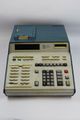
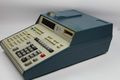
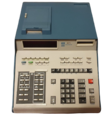
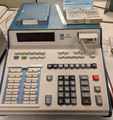
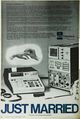
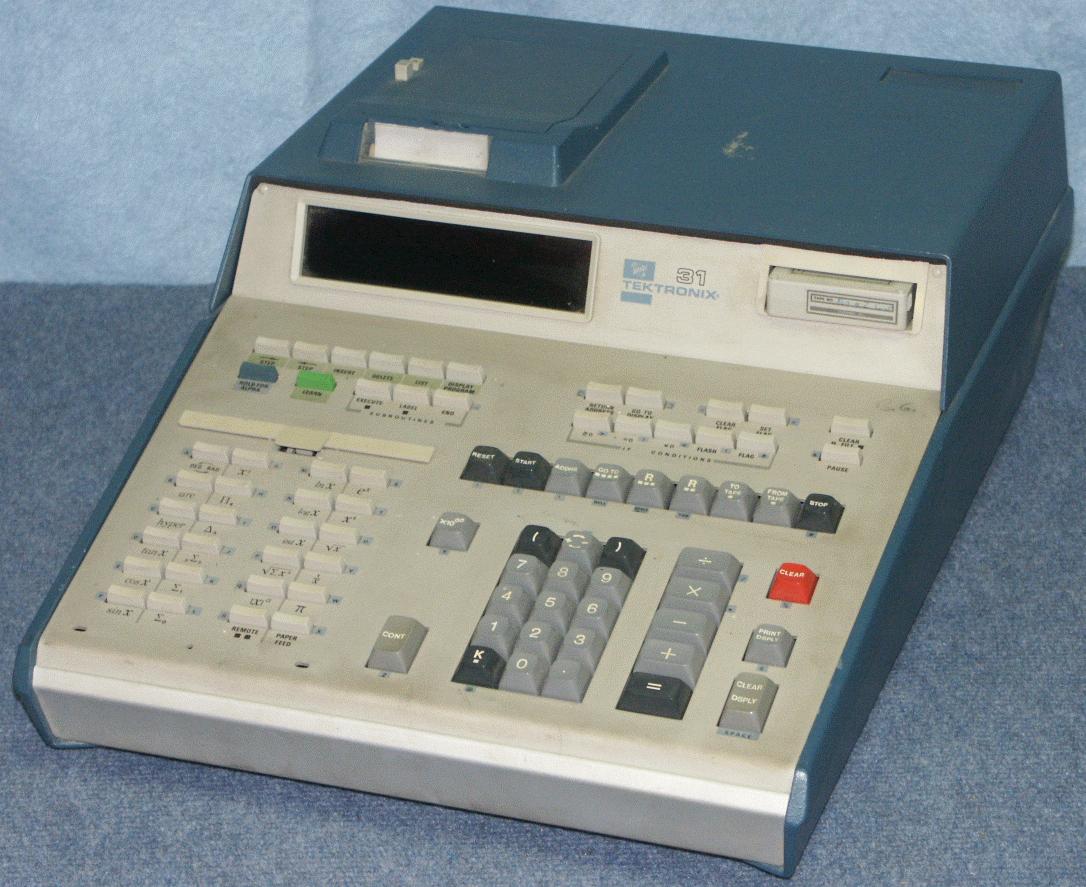
The Tektronix 21 and Tektronix 31 are programmable desktop calculators introduced in August 1973. They feature a complete set of transcendental functions. The 21 supports simple programs (sequences of keystrokes) whereas the 31 supports conditional branching and subroutines.

Key Specifications

Functions

Add, subtract, multiply, divide, reciprocal, logarithm (natural and base 10), exponentiation, square, square root, integerize, Pi recall, triangle formula, factorial

Number of digits

The 21 and 31 displays 10-digit signed numbers but calculates to 12 digits internally (i.e. there are two guard digits). In scientific notation, a signed 2-digit exponent is shown. The number range is 1 × 10-99 ≤ |x| ≤ 9.999999999 × 1099. The manual says,

A googol is defined as 1 × 10100 or 1 followed by 100 zeros. The range of the Tektronix calculator is limited to slightly less than one googol. Is this really a limitation? How big is a googol? [...]

A googol is large indeed. In our world there might not be a googol of anything.

Display

The 31's display makes use of seven-segment planar gas-discharge display modules. Each display module contains two or three digits and a triangular-shaped decimal point to the right of the digits. The mantissa display is made up of one three-digit SP-333 module and four two-digit SP-332 modules, the exponent display is one SP-333. Leading zeroes are not suppressed, i.e. entering the number "5" displays 0000000005.

The display segments glow a bright orange-red when energized. A red filter in situated in front of the display makes the digits appear a deep red to the user.

The calculator's status is indicated by a number of miniature incandescent lamps that are pre-heated to glow faintly when off, for quicker response and longer life.

Printer

The printer in the 21 and 31 is a thermal matrix printer with a fixed 80-element head. It can print 2.4 lines per second on standard 2¼ (57 mm) thermal paper (originally supplied on 250' rolls with a ⅞" core, although smaller rolls will also work). Each line can hold up to sixteen 5×7 matrix digits; on the 31, it has alphanumeric capability as well (uppercase only).

Memory

The base configuration of 1KByte RAM (eight Intel 2102 chips) stores 512 program steps and 64 numeric registers. On the base memory board, there are 24 more sockets for 2102s, allowing expansion in 1K steps up to 4K. An optional auxiliary memory board contains 64 more sockets for up to 8K additional memory. A strap on this board allows the user to change memory partitioning (program step memory vs storage register space). Later models of the Tek 31 had a three-position rocker switch under the tape cartridge slot for this purpose (restart required when changing).

There is also a slot for ROM cartridges on top of the machine, toward the right rear. Tek offered a service to create (P)ROM cartridges from user-supplied programs.

Tektronix 31 Memory Options
Steps Registers
128 192 256 448 640 1000
1024 Option 2
1536 Option 3 -
2048 Option 4 Option 5 Option 8
3584   Option 6
5120 Option 7 Option 9  
8192 Option 10    

Storage

Model 31 cartridges (P/N 020-0082-00) contain 24 feet of 1/4" magnetic tape arranged in an endless loop. The tape stores 6 blocks (numbered 0 to 5) identified by groups of holes in the tape. Each block can hold 1000 program steps or 100 R registers. Density is ~285 bits/inch, tape speed ~7 inches per second.

Model 21 uses a special cartridge that allows a 7.5" magnetic card (P/N 119-0473-00) to be fed into the front of the cartridge, read or written by the transport, then returned to the user through another slot in the front of the cartridge. The card stores 2048 bits.

The 067-0792-00 cartridge is used for aligning the drive.

Interfaces

Several interfaces were available:

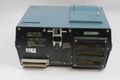
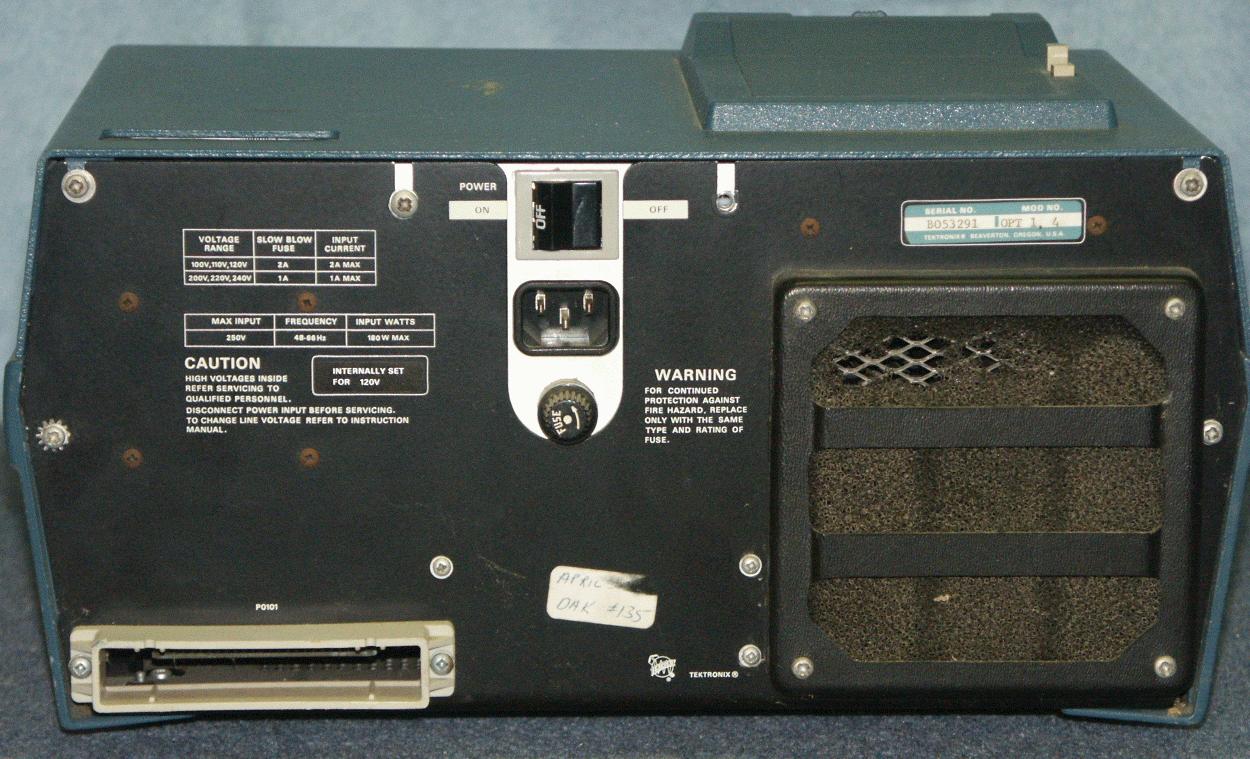
These connect to the calculator through a 50-pin card-edge bus interface with 48 mA open-collector TTL drivers (such as a 7438). The bus can be daisy-chained through multiple peripherals (which all have two matching bus connectors for this purpose), and must be terminated at the last unit. Transfer rates can reach up to 125 kbyte/s.

The bus uses two BCD digits for addressing.

There are separate digit-serial BCD and byte-serial External data buses. Via the BCD bus, the calculator can send numbers to or receive numbers from an external device, in either fixed or scientific notation, or an external device can write directly to the display. The External bus transfers alphanumeric characters (bit 7 = 1), program steps (bit 7 = 0), or binary register content. It supports DMA access to read or write program or register locations. It can also be used to attach an external printer, or execute a subroutine under external control.

System configurations

Links

Documents referencing 31

Document Class Title Authors Year Links
Tekscope 1973 V5 N4 Jul 1973.pdf Article PROGRAMMING – As Easy As Writing A Formula 1973
Tekscope 1973 V5 N4 Jul 1973.pdf Article Reliable By Design 1973
Tekscope 1973 V5 N4 Jul 1973.pdf Article The Tektronix Calculator - It All Adds Up Larry Mayhew 1973
Tekscope 1973 V5 N4 Jul 1973.pdf Article The Calculator and You 1973
Tekscope 1973 V5 N4 Jul 1973.pdf Article A Close-Up Look 1973
A-2797-1.pdf Brochure Tektronix 31/10, the first interactive graphic calculator system 1974
A-2968.pdf Brochure TEKTRONIX 154 Calculator RS-232-C Interface brochure 1974
Tekscope 1974 V6 N3.pdf Article The 31/53 Calculator-based Measurement Instrumentation Package John Mulvey 1974

Patents that may apply to 31

Page Title Inventors Filing date Grant date Links
Patent US 3760370A Calculator with a number processing system Michael J. Cochran 1971-04-26 1973-09-18
Patent US 3831199A Common transport for magnetic tape cartridge or magnetic card cartridge Howard Vollum Sid Broughton 1973-03-19 1974-08-20

Prices

31 without printer
Year Catalog price In 2026 dollars
1975 $2,850 ~$17,700
1978 $3,350 ~$17,200
 
31 with printer
Year Catalog price In 2026 dollars
1975 $3,550 ~$22,000
1978 $4,150 ~$21,300

The 31 is last listed in the 1978 catalog as an "OEM Scientific Calculator", and mentioned indirectly in 1979 where the WP1100 last appeared (without a price).

Internals

The 21 and 31 are built around a custom LSI chip set, the 156-0243-00 Adder-Subtracter, 156-0238-00 Working Register Storage (2×), 156-0239-00/156-0240-00/156-0242-00 Function Decoding, 156-0235-00 Microcode Routine Address ROM, 156-0231-00 through 156-0234-00 Microcode ROM/Next Address Latch, 156-0237-00 Timing and Constant Storage ROM, 156-0236-00 K Register Storage (2×) and 156-0241-00 A & C Operation Control ROM. All of these are packaged in 40-pin DIP. These chips were manufactured by American Microsystems, Inc. as full custom parts.

Pictures

Internal

Replacement display board

When the 31's gas-discharge display modules are failing, they are not only difficult to obtain, but also very hard to replace due to the conformal coating of the board. Volunteers at the VintageTek museum have therefore developed a drop-in replacement display board with a microcontroller driving modern LEDs. This board can take the place of the original without requiring further modifications of the calculator.

The Museum sells the board through their eBay store to support the Museum's operations.

Components

Some Parts Used in the 31

Part Part Number(s) Class Description Used in
150-0048-01 150-0048-01 Discrete component 5 V, 60 mA, T-1 miniature incandescent lamp 21 (calculator) 31 576 SW503
DM8880 156-0284-00 Monolithic integrated circuit display driver 21 (calculator) 31
Intel 2102 156-0291-00 156-0291-01 156-0893-00 156-0893-01 Monolithic integrated circuit 1K×1 static RAM 21 (calculator) 31 833 DF1 DF2 P7001 Nicolet 526
SP-332 150-1015-00 Gas Discharge Tube (display tube) seven-segment planar gas-discharge display 21 (calculator) 31
SP-333 150-1016-00 Gas Discharge Tube (display tube) seven-segment planar gas-discharge display 21 (calculator) 31