1L40

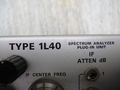
The Tektronix 1L40 is a spectrum analyzer plug-in for 500-series scopes. It covers the frequency range from 1.5 GHz to 40 GHz using four different removable front-end mixer modules.
By default the 1L40 comes with a coaxial mixer, Tek part number 119-0096-00, which works up to 12.4 GHz using a 1N415D detector diode.
Higher frequencies are covered by three waveguide mixers:
- 119-0097-00: 12.4 GHz to 18 GHz
- 119-0098-00: 18 GHz to 26.5 GHz
- 119-0099-00: 26.5 GHz to 40 GHz
Note that the 1L40's display of RF signals is actually back-to-front — lower frequencies are displayed to the right, higher frequencies to the left. This is because the 1st LO is above the input signal frequency, yet the display shows the IF sweep from low to high left-to-right, so the displayed spectrum is inverted.
The 1L40 is also capable of displaying signals in its IF range of 150-250 MHz, because its input is unfiltered so everything passes straight through to the second mixer. In this case, however, the display is left-to-right.
Type 1L40 was produced for only 3 years, making it the shortest-lived letter-series plug-in.
Key Specifications
- please add
Pictures
-

-
-
-
-
-

-
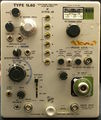
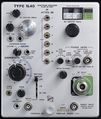
1L40 Front
-
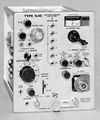
Front view from catalog
-
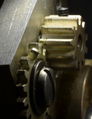
Bent tooth on 1L40 tuning gear provides limit stop in both directions.
-
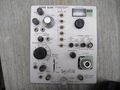
-
-

-
-

-
-
-
-
-
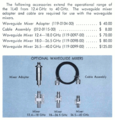
External Mixers and Adaptor
-
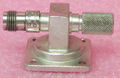
119-0097-00
-
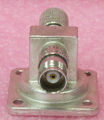
119-0097-00
-
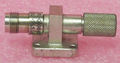
119-0098-00
-
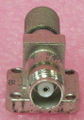
119-0098-00
-
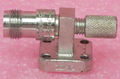
119-0099-00
-
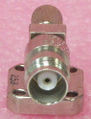
119-0099-00
-
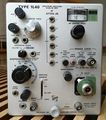
Front view
-
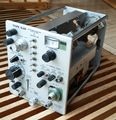
Threequarter view
-
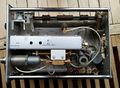
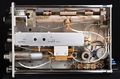
Right side view. Note the housing for the removable input mixer at bottom left, and the tuned cavity for the 1st local oscillator at the top.
-
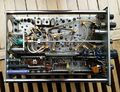
Left side view
-
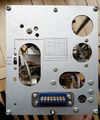
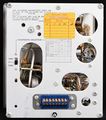
Rear view. Note the selector switch to adapt the sweep input voltage to different models in the 500 series range.
-
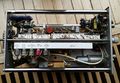
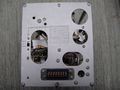
Bottom view
-
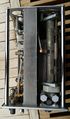
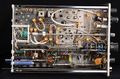
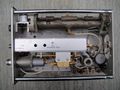
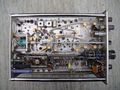
Top view. Cavity for the 1st local oscillator is on the right, and the tuning mechanism is visible. IF filters and attenuators are in the can in the middle.
-
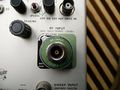
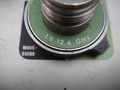
Input connector. This is the basic 1.5-12.4 GHz input, which can be removed and replaced with an extension cable to waveguide mixers for higher frequencies.
-
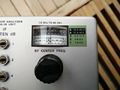
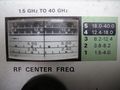
Closeup of RF centre frequency dial. Fundamental range is at the bottom with harmonics above.
-
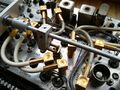
Closeup of part of the dispersion range switch assembly. Note the two little fingers attached to the shaft which operate the toggle switch.
-
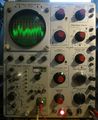
1L40 in 535A mainframe tuned to 2100 MHz cellular band showing signals. 5 MHz/div dispersion.
-
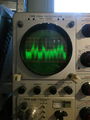
Tuned to 2100 MHz cellular band (5 MHz/div dispersion) showing 3 G data downlinks from various operators. From the right: Orange, T-Mobile, Plus and Play. Photo taken in Warsaw, Poland, January 2018.
-
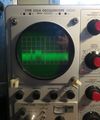
Signals displayed straight through the plugin's 150-250 MHz IF. Dispersion 5 MHz/div, centre frequency 200 MHz. The peak on the left is the local DAB radio multiplex on channel 6B, 183.648 MHz. The hump to the right of that is the local DVB-T multiplex 'Mux 8' on channel 7. Photo taken in Warsaw, Poland, January 2018.


Video
Video of Tuning Limit Stop Mechanism
Components
Some Parts Used in the 1L40
| Part | Part Number(s) | Class | Description | Used in |
|---|---|---|---|---|
| 1N3717 | 152-0381-00 • 152-0125-00 | Discrete component | 4.7 mA, 25 pF tunnel diode | 1L40 • 1S1 • 1S2 • 11B1 • 11B2 • 11B2A • 147A • 1470 • 148 • 21A • 22A • 3B4 • 3B5 • 408 • 432 • 434 • 453 • 453A • 454 • 466 • 491 • 5T3 • 544 • RM544 • 546 • RM546 • 547 • RM547 • 556 • RM556 • 7B70 • 7B71 • 7D11 |
| STD704 | 152-0125-00 | Discrete component | 4.7 mA tunnel diode | 1L40 • 1S1 • 11B1 • 11B2 • 11B2A • 147 • R147 • 147A • R147A • 1470 • 148 • R148 • 148-M • 149 • R149 • 149A • R149A • 21A • 22A • 3B4 • 3B5 • 408 • 432 • 434 • 453 • 453A • 454 • 464 • 465 • 466 • 491 • 5T3 • 544 • RM544 • 546 • RM546 • 547 • RM547 • 556 • RM556 • 7B70 • 7B71 • 7D11 |